
x402 real volume: three public counts, three different questions, and the one count that pays you
Key takeaways
- Three counts, three units: 138 million payments on Base (Chainalysis, Oct 14), 198.9 million settlements across Base, Solana and Polygon (TRM Labs, Sep 9) and a 6.4 million-payment, 35-day sample (BeInCrypto, October). They are not rivals. They measure different things.
- Dollars are the gap: TRM puts the all-time total at $52.7 million, about 26 cents a settlement. The 35-day sample holds $119,900, under two cents a payment.
- Agents are a small slice: after three screens, TRM left $25.62 million, and its two models call 0.6% to 7.5% of that agentic. That is roughly $154,000 to $1.92 million.
- Your own receipts settle it: screen your paid calls for self-payments and bulk payers, then track distinct wallets, repeat wallets and revenue per wallet.
Three counts in five weeks
Pick any headline about x402 this month and you will get a different number. The reason is simple. Each report counts a different unit, over a different window, on a different set of chains.
The oldest is the TRM Labs study “Who's Actually Paying?”, published September 9, 2026 by analyst Noah Hodge. TRM looked at settlements mediated by known x402 facilitators on Base, Solana and Polygon since May 2025. It found 198.9 million of them, worth $52.7 million.
On October 14, Chainalysis reported more than 138 million x402 transactions on Base alone. Most were between $0.0001 and $0.10. Our earlier analysis covers what those payments bought.
A third view came from BeInCrypto's October research report. TokenPost's summary describes a 35-day sample of x402 payments on Base and Solana: about 6.4 million transactions worth $119,900 in total. On October 15, Cryptopolitan put all three side by side, along with a snapshot from the Agent Bazaar directory.
| Source | Window | Chains | Unit | Count | Dollars |
|---|---|---|---|---|---|
| TRM Labs, Sep 9 | May 2025 onward | Base, Solana, Polygon | Facilitator settlements | 198.9 million | $52.7 million |
| Chainalysis, Oct 14 | Through Q3 2026 | Base only | Transactions | 138 million+ | Not published |
| BeInCrypto via TokenPost, Oct | 35-day sample | Base, Solana | Payments | 6.4 million | $119,900 |
Divide dollars by count and the picture changes. TRM's average settlement is about 26 cents. The 35-day sample averages 1.9 cents, and 90.8% of its payments were under one cent. Neither number is wrong. They describe different slices of the same protocol.
How TRM cut 198.9 million settlements to $25.62 million
TRM did not stop at the raw count. It applied three screens, each aimed at activity that looks like commerce but is not:
- Self-payments: addresses paying themselves are removed.
- Bulk flows: volume concentrated between one or two payers and a seller is removed.
- Thin sellers: sellers with fewer than ten distinct buyers are removed.
About half the dollars disappeared. What remained, $25.62 million, TRM treats as plausible commerce. Of the raw $52.7 million, USDC was $52.47 million, or 99.6%.
Then came the hard question: how much of the remainder is an AI agent? TRM ran two tests. The permissive one counts any payer that could plausibly be an agent: facilitator-broadcast payments, sub-dollar averages and varying amounts. The strict one adds sustained monthly activity, plus either a registration in the public ERC-8004 agent registry or payments to more than one seller.
The permissive test gave 7.5%. The strict test gave 0.6%. Applied to $25.62 million, our arithmetic puts agent-like commerce between roughly $154,000 and $1.92 million. That is 0.3% to 3.6% of the headline $52.7 million.
TRM is careful about what it cannot prove. Its sentence deserves quoting: “x402 was designed for agentic commerce, but nothing in the protocol requires an agent.” On a public chain, a scheduled script and an autonomous agent leave the same trace. And TRM warns its method may understate real agents, because a single-purpose agent that calls one service repeatedly looks exactly like a script. Decrypt's September 13 coverage carried the same caveats.
The day 145 addresses sent 1.28 million payments
The 35-day sample explains why raw counts mislead. According to TokenPost's summary, activity peaked on August 26, when 145 addresses sent about 1.28 million payments to just three recipient addresses. That is roughly 8,800 payments per sender, and about one fifth of the whole sample in a single day.
Reports disagree on the Solana share of the sample, so we leave that figure out. The pattern is clear without it. Payments below one cent made up 90.8% of the transactions, yet the sample totals $119,900. When the unit price is a fraction of a cent, a handful of automated senders can move the count by millions without moving revenue.
That is the core problem with a transaction counter. It rewards whoever can send the most requests, not whoever has the most customers.
Agent Bazaar: 246 of 37,292 services cleared a 20-buyer bar
The demand side shows up in the seller directory. Per Cryptopolitan's October 15 report, Agent Bazaar listed 37,292 AI-accessible services that day. Only 246 had at least 20 unique paying agents, about 0.66% of the listings. Their combined projected 30-day revenue was about $78,165, which works out to roughly $318 per qualifying service.
This echoes the September audit of 2026 x402 payments, where the median seller earned $2.50. The long tail lists endpoints. A short head collects the buyers.
Mastercard's launch demo was nine payments
On October 20, 2026, Mastercard opened early access to Agent Pay for Machines, built on x402. PYMNTS reported that the proof of concept, run with the agency Hype, covered nine payments across two independent merchants under one budget. A fuller demonstration is planned at Cloudflare Connect.
Nine payments is a tiny number, and that is the point. The card network's own first showing is not about volume. It is about a buyer with a budget, spending across several sellers with no accounts, API keys or invoices. We looked at the June launch announcement earlier.
A worked example: 100,000 paid calls, screened the TRM way
Here is a screen you can run on your own receipts. The numbers below are invented for illustration. They are not data from any Payzum customer. Assume an API seller charges $0.03 a call and logs 100,000 paid calls in 30 days from 1,200 distinct wallets.
| Step | Paid calls | Revenue | Wallets |
|---|---|---|---|
| Raw 30-day total | 100,000 | $3,000 | 1,200 |
| Remove wallets funded from the seller's own address | -6,000 | -$180 | -3 |
| Remove the two payers sending bulk traffic | -38,000 | -$1,140 | -2 |
| Screened total | 56,000 | $1,680 | 1,195 |
The screened figure is 56% of the headline revenue. TRM's own screens kept about 49% of the dollars across the whole protocol, so a seller who keeps 56% is in a normal range. Now read the four numbers that matter:
| Metric | How to compute it | Example result |
|---|---|---|
| Distinct paying wallets | Unique payer addresses after screening | 1,195 |
| Repeat wallets | Wallets that paid on two or more days | 410 (34.3%) |
| Multi-endpoint wallets | Wallets that paid for two or more of your endpoints | 150 (12.6%) |
| Revenue per screened wallet | $1,680 divided by 1,195 | $1.41 |
Two details carry the lesson. First, the two bulk payers produced 38% of all calls from just two wallets. A seller who reads the raw 100,000 would double the server budget for them. Second, TRM's third screen, ten or more distinct buyers, is the one a seller can simply pass. With 1,195 wallets this seller clears it by two orders of magnitude.
Because x402 payments settle to your own wallet, the payer address of each one is already in your wallet history. Nothing here needs a vendor report.
A five-item checklist for this week
- Export 30 days of receipts from your receiving wallet, with payer address, amount and timestamp.
- Flag self-payments: any payer funded from an address you control, including test wallets.
- Flag bulk payers: any single payer above, say, 10% of calls. Check whether they return on other days.
- Compute the four metrics in the table above on what is left.
- Re-check the unit: if most screened payments are under a cent, bundle calls so one payment lands in the one-to-ten-cent band where buyers already transact. The price-floor analysis shows why tiny units are uneconomic.
Where Payzum fits
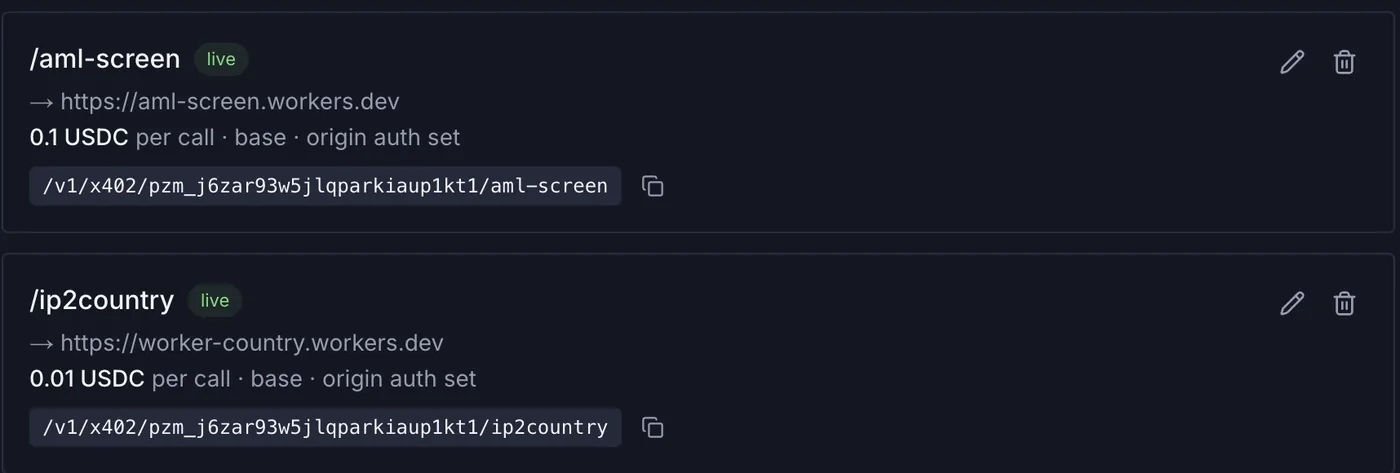
Payzum sits in front of your existing API as x402 middleware, a proxy. It is not the facilitator and it never holds your funds. In the dashboard you enter your endpoint, the API key or bearer token it expects and a price per call. Payzum publishes an x402 URL and answers agents with the 402 Payment Required. The USDC payment on Base settles through an external facilitator, currently Coinbase's, straight to your wallet. Payzum then forwards the paid request to your real endpoint with your key.
You write no code and implement no protocol, so an API provider can start the same day. Pricing is about 1,000 x402 transactions a month free, then roughly $0.001 per transaction plus gas. Because the money lands in your wallet, the receipts for the screen above are yours from the first call. More on the x402 page.
Pushback we expect
“If agents are 0.6% to 7.5%, is x402 a bust?”
No. TRM measures what it can prove on a public chain, and says its method may understate single-purpose agents. Scripts, bots and automation also pay real money for real endpoints. The protocol never required an agent. A buyer is a buyer if it comes back.
“Should I just wait until the numbers get bigger?”
Waiting saves nothing. Making an endpoint payable is a dashboard setup, and the buyers who show up first are the ones who show up again. What you gain by starting is your own data, which is worth more than any third-party count.
“Do I need a vendor to tell me which buyers are agents?”
You do not need to know. Distinct wallets, repeat wallets and revenue per wallet answer the business question whether the payer is a person's script or an autonomous agent.
Frequently asked questions
How many x402 payments are real?
It depends on the filter. TRM Labs counted 198.9 million settlements worth $52.7 million since May 2025, and kept $25.62 million as plausible commerce after removing self-payments, bulk flows and thin sellers. Of that, 0.6% to 7.5% looked like AI agents under its two models.
Why do Chainalysis and TRM report different x402 numbers?
They count different things. Chainalysis counted more than 138 million transactions on Base through Q3 2026. TRM counted 198.9 million facilitator settlements across Base, Solana and Polygon since May 2025, then screened them for commerce. Different chains, windows and units give different totals.
How much money has x402 processed?
TRM Labs puts the total at $52.7 million across 198.9 million settlements, with 99.6% in USDC. A separate 35-day sample reported by TokenPost found 6.4 million payments worth $119,900. Chainalysis published a transaction count and no dollar total.
How can an API seller measure real x402 demand?
Export payments from your receiving wallet and remove self-payments and bulk payers. Then track distinct paying wallets, wallets that pay on two or more days, wallets using several endpoints and revenue per wallet. Those four numbers show whether buyers return.
Does Payzum report which x402 buyers are AI agents?
No. Payzum is the middleware in front of your API: it publishes the x402 URL, returns the 402 and proxies paid calls, while an external facilitator settles USDC to your wallet. It does not classify payers as agents or scripts. Your wallet history holds the payer addresses.
Count your own x402 revenue first
Three public counts will keep disagreeing. The number that matters is yours: how many distinct wallets paid, and how many came back. Book 20 minutes with our team and we will set up an x402 endpoint in front of your API, non-custodial, so you start collecting that number.
Calendar not loading? Book a meeting directly · sales@payzum.com
This article analyzes the TRM Labs study published September 9, 2026, Chainalysis' October 14, 2026 report, TokenPost's summary of BeInCrypto's October research, Cryptopolitan's October 15 comparison and PYMNTS' October 20 report on Mastercard. Third-party figures may be revised. The worked example uses invented numbers for illustration. Nothing here is legal, tax or financial advice.